

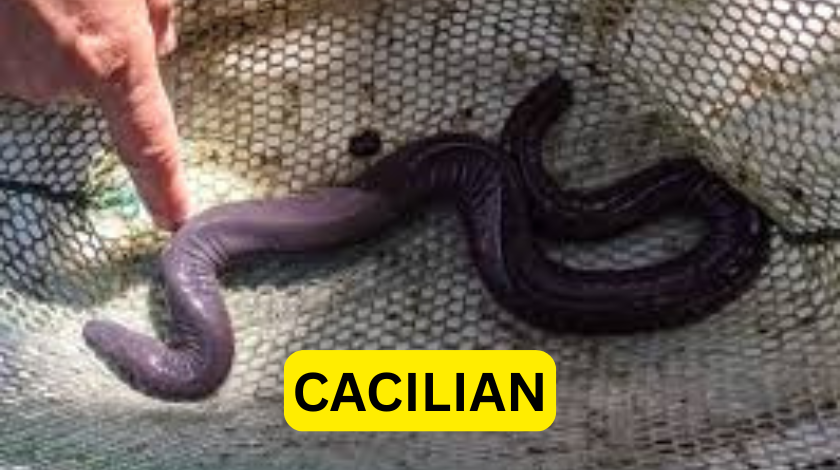
I still remember the first time I saw a picture of a caecilian. I was browsing a wildlife magazine, and my brain short-circuited for a second. It looked like a large, glossy earthworm, or maybe a strange, sleek snake. The caption, however, read “Caecilian.” I had to sound it out in my head: “Suh-SILL-ee-an.” I’d studied biology for years, but this creature was a complete mystery to me. How could an entire order of amphibians be so unknown to the average person, even to someone with a keen interest in nature?
That initial confusion is probably what draws me to them. In a world where we think we’ve seen it all, caecilians are a wonderful reminder of how much mystery still exists, often right beneath our feet. They are the third group of amphibians, living in the shadows of their famous cousins, the frogs and salamanders. But to call them obscure is an injustice. They are some of the most uniquely adapted and fascinating animals on the planet.
So, let’s pull back the soil and shine a light on these enigmatic creatures. This isn’t just a list of facts; it’s an invitation to explore a hidden world, one that will change the way you think about amphibians forever.
So, What Exactly is a Caecilian?
Let’s start with the basics. A caecilian is an amphibian. This is the most crucial piece of information and the one that most often surprises people. They belong to the order Gymnophiona, while frogs and toads are Anura, and salamanders are Urodela. All three groups are amphibians, meaning they are cold-blooded vertebrates that typically have a larval stage living in water and an adult stage that can live on land, though their skin requires moisture.
But that’s where the obvious similarities end. Unlike a frog with its powerful legs or a salamander with its delicate limbs, caecilians have no legs whatsoever. Their name, in fact, comes from the Latin word caecus, meaning “blind,” which is a bit of a misnomer as we’ll discover. Their body is long, cylindrical, and segmented, giving them an uncanny resemblance to a giant worm or a small snake. This body plan is a perfect example of evolution finding a similar solution to a common problem: how to move efficiently through a tight, dense environment like soil or mud.
I find it helpful to think of them as nature’s excavators, the underground engineers of the amphibian world. While frogs are leaping and salamanders are crawling, caecilians are tunneling, their lives playing out in a world of darkness and pressure.
Read Also: The Gaston Gazette: Your Trusted Source for News in Gastonia, North Carolina
Not a Snake, Not a Worm: Unveiling the Caecilian’s Body
This is where we get into the really good stuff. At a glance, it’s easy to see why people get confused. But a closer look reveals a suite of features that are entirely unique to caecilians.
First, let’s talk about their skin. It is smooth, glossy, and often very colorful, with some species sporting bright yellows, blues, or patterns. It’s not slimy like a frog’s, but it is packed with glands that keep it moist and sometimes produce toxins to deter predators. Beneath the skin, many species have tiny, embedded scales, a relic from an ancient past that other amphibians have completely lost. This combination of smooth, moist skin with hidden scales is a dead giveaway that you’re not looking at a reptile.
Then there’s the head. A caecilian’s head is blunt and robust, built like a battering ram for burrowing. It is incredibly hard and bony, allowing it to push through soil without collapsing. And yes, they have teeth. Quite a lot of them! Their teeth are sharp and pointed, designed for grabbing and holding onto slippery prey like earthworms.
Now, for one of their most amazing features: the tentacle. Located on their face, between their eye and nostril, is a small, retractable sensory tentacle. This isn’t something you see on every animal. This tentacle is a chemosensory organ, meaning it picks up chemical signals from the environment. Think of it as a combination of our senses of smell and taste, but on a highly specialized, extendable stalk. When a caecilian is burrowing, it can extend this tentacle to sample the soil and water around it, “smelling” for prey or predators without having to open its mouth. It’s a phenomenal adaptation for life in the dark.
And what about those “blind” eyes? Their eyes are indeed very small and often covered by a layer of skin or even bone, protecting them from abrasion while digging. They are not completely blind; they can likely detect light and shadow, which helps them know if they’ve been uncovered. But their primary way of navigating the world is through their tentacle and their sense of smell. They are masters of a world without light.
A Life in the Dark: Caecilian Habitat and Behavior
Where does one find these secretive animals? Caecilians are creatures of the tropics. You will find them in the warm, humid soils of Central and South America, Africa, and South and Southeast Asia. They need constant moisture, so they thrive in rainforests, near streams and rivers, and in other damp environments.
Their entire lifestyle is built around their burrowing nature. They are fossorial, spending most of their lives underground. They move by pushing their hard head into the soil and then contracting their powerful body muscles in waves, which propels them forward. It’s a bit like how an earthworm moves, but much more powerful and efficient. Some species, however, are aquatic, living in slow-moving rivers and swamps. These aquatic caecilians have a more flattened body and a fin-like ridge along their back to help them swim.
Their diet is exactly what you’d expect from a predator of the underworld. They are carnivorous, primarily feasting on invertebrates like earthworms, termites, ants, and other insects and their larvae. They are sit-and-wait predators or active foragers in their tunnels. When they encounter prey, they grab it with their numerous teeth and, in a fascinating behavior, can actually rotate their entire body while holding on, essentially spinning to subdue and consume their meal. It’s a brutal, efficient dance in the dark.
The Circle of Life: How Caecilians Reproduce
If you thought their anatomy was strange, wait until you hear about their reproduction. This is, in my opinion, the most incredible aspect of their biology. Caecilian reproduction is a showcase of extreme parental care that rivals anything in the animal kingdom.
Some caecilians lay eggs, like many other amphibians. The mother will typically coil her body around the clutch of eggs to protect them from predators and keep them moist. But the real magic happens in the live-bearing species. In these caecilians, the eggs are retained inside the mother’s body, and the embryos develop there, receiving nourishment directly from her.
But here’s the truly mind-blowing part: how the babies eat. In both some egg-laying and live-bearing species, the young are born with a special set of temporary, spoon-shaped teeth. They use these teeth to feed on a unique substance produced by their mother. No, it’s not milk. It is the outer layer of her skin.
The mother develops a special, thickened, and nutrient-rich layer of skin, often called a “brood patch.” The litter of young, using their special teeth, will systematically scrape and eat this skin. They will do this every few days for weeks as they grow. The mother’s skin regenerates, providing a continuous food source. This behavior, known as dermatotrophy or skin feeding, is a level of maternal investment that is almost unheard of in amphibians. Imagine a mother not just carrying her young, but literally nourishing them with her own body, layer by layer, until they are strong enough to venture out on their own. It’s a profound and humbling example of the lengths life will go to ensure the survival of the next generation.
Are Caecilians in Danger?
With lives so hidden, it is very difficult for scientists to assess the conservation status of most caecilian species. Many are known only from a single specimen found decades ago. However, like most amphibians, they face significant threats.
The primary danger is habitat loss. The rainforests and wetlands they call home are being cleared for agriculture, urban development, and logging. When the soil is turned over and the delicate, moist ecosystem is destroyed, caecilians cannot survive. They are also vulnerable to pollution, as their permeable skin can easily absorb pesticides and other chemicals from the soil and water.
Because they are so poorly studied, a population could be declining drastically without us even knowing. They are a silent casualty of environmental degradation. Protecting them means protecting the complex, hidden ecosystems within the soil, a reminder that conservation isn’t just about the charismatic tigers and pandas, but also about the mysterious, limbless diggers that maintain the health of the earth from within.
Conclusion
Caecilians are a testament to nature’s boundless creativity. They break all our stereotypes about what an amphibian should be. They are legless, they are burrowers, they have sensory tentacles, and they exhibit some of the most dedicated parenting in the animal kingdom. They teach us that understanding the natural world requires looking beyond the obvious, beyond what leaps and crawls in the open, and delving into the hidden, secret places.
My journey from not knowing what a caecilian was to being utterly captivated by them is one I hope you’ve shared through this article. The next time you are in a tropical region, walking on a patch of soft, wet soil, remember that you might be walking over a world of astonishing creatures, living their complex lives just out of sight. They are a beautiful mystery, and in a way, I’m glad they’ve remained one for so long.
Frequently Asked Questions (FAQ)
Q1: Are caecilians poisonous?
A: Some species are. They have glands in their skin that produce a toxin. While not typically dangerous to humans, it can be a effective deterrent against predators. It’s always best to avoid handling any wild animal you cannot positively identify.
Q2: What is the difference between a caecilian and a worm?
A: This is a great question. The biggest difference is that a caecilian is a vertebrate with a backbone and a complex internal skeleton, while a worm is an invertebrate. Caecilians also have a distinct head with teeth and eyes, a more complex nervous system, and they reproduce in more advanced ways, unlike the simple reproduction of worms.
Q3: What is the largest caecilian species?
A: The largest known species is the Thompson’s Caecilian (Caecilia thompsoni), found in Colombia. It can grow to over 1.5 meters (almost 5 feet) in length, making it a truly impressive subterranean giant.
Q4: Can you keep a caecilian as a pet?
A: This is generally not recommended and is often illegal. They have very specific and difficult-to-replicate care requirements, needing a constant, deep, moist substrate to burrow in and a diet of live invertebrates. Their secretive nature also means you would rarely see them. They are best appreciated in the wild or through reputable educational resources.
Q5: How many species of caecilian are there?
A: As of now, there are over 200 recognized species, and new ones are still being discovered as scientists explore more remote tropical regions.


