

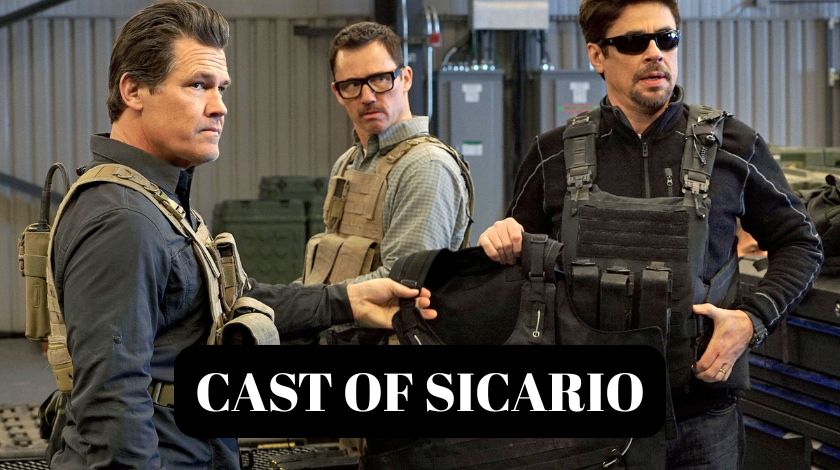
I remember the first time I watched Sicario. It wasn’t like other action movies or crime thrillers I had seen. There was no clear hero to cheer for, no moment of triumphant victory. Instead, I left the film feeling a deep, unsettling quiet, as if I had been shown a terrible truth I couldn’t unsee. That feeling, that power, doesn’t come from a clever plot twist or spectacular explosions. It comes directly from the people on the screen—the cast of Sicario. These aren’t just characters; they are shattered souls navigating a moral desert, and their performances are so raw and real that they stick with you for years.
If you are here, you probably felt that too. You want to understand what makes Alejandro so compelling, why Kate’s story is so heartbreaking, or how Matt Graver can be so charming and terrifying at the same time. This isn’t just a list of actors and their roles. This is a deep dive into the very heart of Sicario, exploring the brilliant actors and the devastatingly human characters they brought to life. We will unpack their motivations, their pain, and the masterful filmmaking that tied it all together, creating one of the most critically acclaimed and thought-provoking films of the last decade.
The Beating Heart and Shattered Soul: Benicio del Toro as Alejandro Gillick
Let’s start with the performance that everyone talks about: Benicio del Toro as Alejandro Gillick. On the surface, he is a mysterious “advisor” working with the US government. He is quiet, watchful, and moves with a predatory stillness. But del Toro, in an Oscar-nominated performance, does something extraordinary. He lets you see the profound, bottomless grief hiding just beneath that calm exterior. Alejandro isn’t just a hired gun; he is a ghost, a man powered entirely by a personal tragedy so immense it has consumed everything he once was.
We learn that he was once a prosecutor in Ciudad Juárez, a man who believed in the law and justice. That life was obliterated when a powerful drug cartel murdered his wife and daughter. This backstory isn’t just a footnote; it is the entire engine of his character. Every move he makes, every life he takes, is a step on his single-minded path of vengeance. He is not fighting the drug war for America or for some grand political ideal. He is fighting a private war, and the US government, in the form of Josh Brolin’s Matt Graver, is simply giving him the weapons and the license to do it.
The genius of del Toro’s performance is in the silence. He doesn’t need to give a big, emotional speech about his pain. You can see it in his eyes—a hollow, ancient sadness. You can see it in the way he carries himself, as if the weight of his loss is a physical burden. I often think about the scene where he comforts a terrified Kate Macer during a chaotic firefight at the border. For a moment, he seems almost paternal, a protector. But this is immediately undercut by the chilling realization that his kindness is a tool. He is isolating her, making her dependent on him, because he needs her compliance for his own ends. Del Toro masterfully plays this duality: the man who can show a flicker of humanity one second and execute a man in front of his family the next.
And then there is the film’s climax, the dinner table scene. It is, without a doubt, one of the most tense and terrifying sequences in modern cinema. Alejandro, having infiltrated the cartel leader’s home, sits down with the man responsible for his family’s murder. He is calm, almost polite. He recites a bedtime story to the man’s children, a story that mirrors his own loss. In that moment, del Toro is not just an actor; he is the embodiment of vengeance itself—patient, precise, and utterly merciless. He is not a “good guy.” He is a tragic figure, a man whose soul was murdered long before his body will be, and he represents the horrifying, cyclical nature of the violence the film depicts.
Read Also: The Wii U: Nintendo’s Misunderstood Masterpiece | A 2024 Retrospective
The Broken Compass: Emily Blunt as Kate Macer
If Alejandro is the ghost of the drug war’s past, then Emily Blunt’s Kate Macer is its present and future. She is us, the audience. She is the person who enters this world with a rulebook, a moral code, and a belief that right and wrong are clearly defined. Her journey throughout the film is the systematic dismantling of that belief, and Blunt’s performance is a masterclass in slow-burn trauma.
When we first meet Kate, she is a highly competent and idealistic FBI agent leading a Kidnapping Response Team. She believes in doing things the right way, with warrants and clear jurisdiction. After a brutal raid on a cartel-safe house in Arizona reveals a house of horrors, she volunteers for a shadowy inter-agency task force, thinking it is her chance to really make a difference. This is her first and most critical mistake. She is a lamb walking into a wolf’s den, and she doesn’t even know it.
Blunt portrays Kate’s descent with incredible subtlety. It starts with small moments of confusion and unease. The casual disrespect from her new colleagues, the lack of clear briefing, the way Matt Graver dismisses her questions with a smirk. Her body language tells the story as much as her dialogue. Watch her in the scene where the task force, in armored vehicles, pushes into Mexico to extradite a cartel boss. She is wide-eyed, claustrophobic, and utterly terrified as they are swarmed by cartel lookouts. Blunt makes you feel that fear viscerally. You are trapped in that vehicle with her, realizing that this is not a clean, professional operation. It is an act of war, and she is a pawn.
Her relationship with Alejandro is the core of her undoing. He is the one person who seems to offer her guidance and protection in this insane world. He saves her life. He explains the brutal reality of the cartels. She wants to trust him, to see a fellow professional in him. But this trust is brutally betrayed in the film’s final act. When she follows him, trying to stop him from carrying out his extrajudicial execution, he turns on her. He holds her at gunpoint, forces her to sign a false document, and tells her the chilling truth: “You are not a wolf, and this is a land of wolves now.”
That line is the final blow. It shatters whatever is left of her idealism. The final shot of Kate, lowering her gun in surrender after a potential threat turns out to be just a family enjoying a barbecue, is devastating. She has been so traumatized that she sees enemies everywhere, but the real war was inside her all along. She has lost her moral certainty, and Blunt’s face in that moment is a perfect portrait of a person hollowed out by a truth too ugly to bear.
The Smiling Architect of Chaos: Josh Brolin as Matt Graver
While Alejandro is the weapon and Kate is the target, Josh Brolin’s Matt Graver is the man who pulls the trigger. He is the personification of American realpolitik in the drug war—a cheerful, cynical, and ruthlessly pragmatic CIA operative. Brolin plays him with a laid-back, almost slacker-like demeanor that makes him all the more frightening. He wears flip-flops and t-shirts to top-secret briefings. He cracks jokes. But behind that easygoing smile is a man who views morality as a weakness and human life as a currency to be spent.
Graver’s entire operation is built on a lie. He recruits Kate not for her skills, but for her credibility. She is his “rabbit in the weeds,” a legitimate FBI agent whose presence will lend his illegal incursion into Mexico a veneer of legitimacy. He never has any intention of letting her in on the real plan, which is to use Alejandro to ignite a war between two cartels, letting them weaken each other so a more “manageable” cartel can take over. It is a monstrous plan, but Graver discusses it with the casual air of a man planning a business merger.
What I find so fascinating about Brolin’s performance is how he uses relaxation to convey power. He is never ruffled, never angry. When Kate confronts him, demanding answers, he doesn’t shout; he just smiles and patronizes her. In one key scene, he explains the nature of their mission to her. He says they have to “dramatically overreact” and “create chaos” to get the cartels’ attention. He says this while casually eating a sandwich, as if he’s talking about the weather. This contrast is the point. For Graver, this isn’t personal. It isn’t about justice or vengeance. It is a geopolitical game, and the horrific violence is just a strategic move on a chessboard. He is arguably more frightening than Alejandro because he feels no passion, only cold, calculated purpose.
The Foundation of Reality: The Supporting Cast of Sicario
A film this strong doesn’t work without a powerful supporting cast that builds out the world and adds layers of authenticity. Before he was a household name from Get Out and Nope, Daniel Kaluuya played Reggie Wayne, Kate’s loyal FBI partner. Kaluuya brings a grounded warmth and skepticism to the role. He is Kate’s anchor to the real world, the voice of reason who is immediately suspicious of Graver and his team. His presence makes Kate’s isolation feel more profound once he is deliberately sidelined from the mission.
Then there are the smaller, but no less impactful, roles. Victor Garber plays a straight-laced CIA official who provides the bureaucratic cover for Graver’s operation, representing the system that enables such morally grey actions. Jon Bernthal has a brief but memorable role as Ted, a dubious local cop who tries to cozy up to Kate. His character serves as a reminder that corruption and danger are not just “over there” in Mexico; they are embedded at every level of this conflict, even in a simple American bar.
And we cannot talk about the cast without tipping our hats to the man behind the camera, director Denis Villeneuve. A director’s job is to guide performances and create an environment where actors can do their best work. Villeneuve, along with a stunning script from Taylor Sheridan and the legendary cinematography of Roger Deakins, created the tense, atmospheric, and morally heavy world that these actors inhabited. The long, silent shots, the ominous score by Jóhann Jóhannsson, the vast, imposing landscapes—all of these elements worked in concert with the actors’ performances to create a unified and unforgettable cinematic experience. The cast didn’t just act in a vacuum; they were pieces in a larger, meticulously crafted vision.
Conclusion: The Enduring Legacy of a Masterful Ensemble
Years later, the cast of Sicario remains a benchmark for what ensemble acting can achieve in a thriller. They didn’t just play parts; they embodied the central themes of the film—the loss of innocence, the cost of vengeance, and the terrifying ambiguity of a world where the lines between good and evil have been erased. Emily Blunt, Benicio del Toro, and Josh Brolin gave career-defining performances, each one a crucial pillar supporting a story that is as intellectually challenging as it is emotionally draining.
When I rewatch Sicario, I am always struck by how it refuses to give easy answers. It doesn’t tell you who to root for. It simply presents these broken, complex people and forces you to watch as they navigate a hell of their own making. That is the power of great casting and great acting. It is not about star power; it is about truth. And the painful, haunting truth delivered by the cast of Sicario is that in the endless, grinding war on drugs, there are no victories, only survivors and ghosts.
Frequently Asked Questions (FAQ)
Q1: Who played the main character, Alejandro, in Sicario?
A1: The role of Alejandro Gillick was played by the immensely talented Benicio del Toro. His performance was widely praised and earned him an Academy Award nomination for Best Supporting Actor.
Q2: Why wasn’t Emily Blunt’s character, Kate, in the sequel Sicario: Day of the Soldado?
A2: This was a creative decision by the writer, Taylor Sheridan. He felt that Kate Macer’s story was complete. Her arc in the first film was about the loss of her idealism, and bringing her back into the dark world of the sequel would have felt repetitive and undermined her journey.
Q3: What is Josh Brolin’s role in the movie?
A3: Josh Brolin plays Matt Graver, a CIA special activities division officer who leads the shady task force. He is the cynical and pragmatic architect of the operation who recruits Kate and enables Alejandro’s quest for vengeance.
Q4: Are the characters in Sicario based on real people?
A4: While the specific characters are fictional creations of writer Taylor Sheridan, they are very much inspired by the real-world realities of the drug war. The characters represent archetypes: the disillusioned idealist (Kate), the vengeful victim (Alejandro), and the amoral government operative (Matt).
Q5: Who directed Sicario?
A5: The film was directed by the acclaimed Canadian director Denis Villeneuve, who is also known for other masterpieces like Arrival, Blade Runner 2049, and Dune.


