

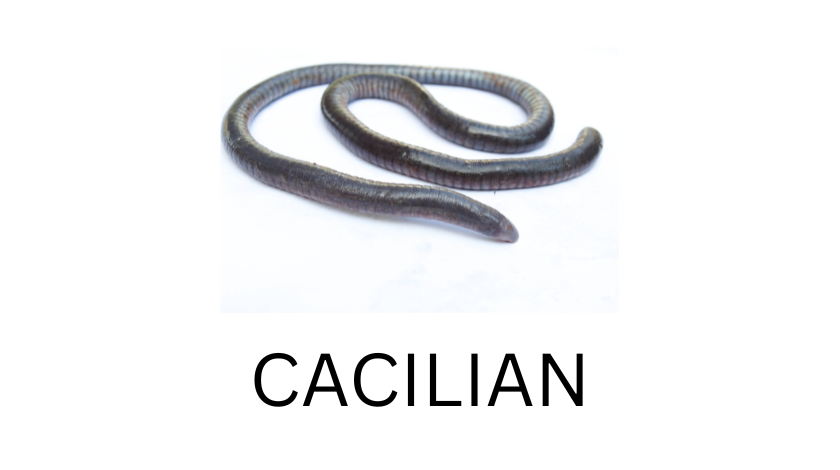
Imagine you are digging in a garden in a tropical forest, and your shovel turns up what looks like a giant, glossy earthworm. But as you look closer, you see a subtle, almost grumpy-looking face with tiny, hidden eyes. You might have just met one of the most overlooked and mysterious creatures on our planet: the caecilian.
I have been fascinated by unusual animals since I was a child, but I distinctly remember the first time I read about caecilians. It felt like discovering a secret. Frogs and salamanders get all the attention in the amphibian world, but this third group, slithering silently through the soil and water, is arguably the most intriguing. In this article, we will pull back the curtain on these enigmatic animals. We will explore what they are, how they live, and why they deserve a spot in your imagination right next to pandas and dolphins.
What in the World is a Caecilian? Breaking Down the Basics
Let us start with the most fundamental question: what is a caecilian? The name itself, pronounced “seh-SILL-yen,” comes from the Latin word for “blind,” which gives you a clue about one of their key features. In the simplest terms, caecilians are amphibians. This places them in the same grand class of animals as frogs and salamanders. They are cold-blooded, have porous skin that needs to stay moist, and many of them breathe through their skin in addition to their lungs.
However, that is where the obvious similarities end. Unlike a leaping frog or a walking salamander, caecilians have completely lost their legs over millions of years of evolution. Their bodies are long, cylindrical, and perfectly adapted for a life spent burrowing underground or swimming in slow-moving water. Think of them as the amphibians that decided to specialize in being long and sleek, trading legs for a powerful, worm-like form that lets them navigate through soil and mud with incredible ease. They are found in tropical regions of Central and South America, Africa, and southern Asia, always preferring humid, wet environments where their skin won’t dry out.
Read Also: Progress Energy: Your Modern Guide to Bill Pay, Outages, and Customer Service
Not a Snake, Not a Worm: The Anatomy of a Caecilian
This is where things get really interesting. At a quick glance, it is easy to mistake a caecilian for a large worm or a small snake. But if you know what to look for, the differences are striking.
First, let us talk about their skin. A caecilian’s skin is smooth, glossy, and often darkly colored, but it is also packed with glands and sometimes even has tiny, fish-like scales embedded within it. This is a feature you will never find on a frog or salamander. Their skin is also layered in folds, called annuli, which make them look like they are made of stacked rings. This segmented appearance is part of why people think “worm,” but a worm’s body is much simpler.
Now, about those eyes. Caecilians are not completely blind, but their eyes are tiny and often covered by a layer of skin or bone, making them mostly useless in their dark underground world. They do not rely on sight to navigate. Instead, they have a unique and amazing sensory tool: a tentacle. Located between their eye and nostril, this small, retractable tentacle acts like a combination of a nose and a hand. It picks up chemical signals from the environment, helping the caecilian “smell” and “taste” its surroundings to find prey and avoid predators. It is a bit like a built-in GPS and food detector all in one.
Their heads are strong and somewhat bullet-shaped, perfect for pushing through soil. Inside that head, they have a powerful set of jaws and teeth. This is a dead giveaway that they are not worms. Earthworms eat soil and decaying matter, but caecilians are predators. Their teeth are designed for grabbing and holding onto wriggling prey.
A Hidden Life: Where Caecilians Live and What They Eat
Because of their secretive nature, pinpointing exactly where all caecilian species live is a challenge for scientists. However, we know they are creatures of the wet and warm parts of the world. You will not find a caecilian burrowing in a dry, temperate field. Their world is the damp soil of rainforests, the mud along riverbanks, and the leaf litter of dense jungles. Some species are entirely aquatic, preferring the slow-moving waters of streams and swamps. These aquatic caecilians look more like eels and have a flattened tail for swimming.
Their diet reflects their life as hidden hunters. Caecilians are carnivores, and their menu consists of other small creatures that share their underground or watery homes. They eat earthworms, termites, insect larvae, small spiders, and even other amphibians. Their hunting technique is all about sensing vibration and scent. They will follow the chemical trail of an earthworm or sense its movements in the soil, then swiftly snatch it with their jaws. I like to think of them as the subterranean equivalent of a shark, a top predator in their very specific, dark realm.
The Circle of Life: How Caecilians Reproduce and Care for Young
If you thought caecilians could not get any more fascinating, their reproductive strategies will truly astonish you. This is one area where they dramatically outperform their frog and salamander cousins in terms of parental investment.
Some caecilian species lay eggs, much like other amphibians. But the story does not end there. The mother caecilian does not just abandon her eggs. She will coil her body around them, guarding them from predators and possibly even keeping them moist. When the larvae hatch, they are often on their own.
However, many caecilian species have taken this a step further and give birth to live young. This process, called viviparity, means the babies develop inside the mother. But here is the most incredible part: how the mother feeds them. While the babies are developing inside her, they do not have a placenta like mammal babies do. Instead, they grow a special set of teeth. They use these teeth to gnaw on the lining of their mother’s oviduct, the tube where they are growing. The mother’s body produces a thick, nutrient-rich substance, and the babies literally scrape it off with their special teeth to eat. It is a form of milk, but not from mammary glands. This intense form of parental nourishment comes at a great cost to the mother, making her investment in her offspring one of the most significant in the entire amphibian world.
Caecilian vs. Snake: A Simple Guide to Telling Them Apart
This is probably the most common point of confusion, so let us clear it up once and for all. How can you tell a caecilian apart from a snake?
-
Skin: A snake’s skin is covered in dry, overlapping scales. A caecilian’s skin is smooth, moist, and may have tiny, embedded scales, but it feels completely different.
-
Eyes: Snakes have prominent, unblinking eyes that are always visible. Caecilians have tiny, often hidden eyes that are barely noticeable.
-
Face: Look for the tentacle. Only caecilians have that small, retractable tentacle between the eye and nostril. Snakes do not have this.
-
Jaws: Snakes can unhinge their jaws to swallow large prey whole. Caecilians have a fixed, strong jaw for grabbing smaller prey.
-
Biology: This is the most important difference. Snakes are reptiles. They have scales, lay eggs with leathery shells (or give birth to live young), and are more independent of water. Caecilians are amphibians. They have permeable skin, are tied to moist environments, and their life history is fundamentally different.
Why Caecilians Matter: The Importance of These Mysterious Creatures
You might wonder why we should care about a creature most of us will never see. The truth is, caecilians play a vital role in their ecosystems. As predators, they help control populations of invertebrates like insects and worms. As prey, they are a food source for birds, snakes, and mammals. Their constant burrowing aerates the soil, much like earthworms do, which helps water and nutrients penetrate the ground, benefiting plant roots and the overall health of the forest floor.
Furthermore, studying caecilians can teach us a great deal about evolution and biology. Their unique reproductive methods, their sensory tentacle, and their limbless bodies offer insights into how animals adapt to extreme environments. Scientists are even studying a species of caecilian that lacks lungs entirely, breathing only through its skin and the lining of its mouth. Understanding these adaptations could have implications for human medicine and our knowledge of biological limits.
Conclusion: Unraveling the Mysteries
Caecilians are a powerful reminder that our planet still holds countless wonders and mysteries. They are not as charismatic as a tiger, nor as familiar as a songbird, but their strange and secretive lives are a testament to the incredible diversity of life. They have evolved a perfect set of tools for a life in the dark, from their powerful, legless bodies to their sensory tentacles and astonishing parental care. The next time you think of amphibians, I hope you will remember the caecilian, the third amphibian, quietly and efficiently playing its part in the great tapestry of nature, just beneath our feet.
Frequently Asked Questions About Caecilians
1. Are caecilians poisonous?
Some caecilian species are, in fact, poisonous. They have glands in their skin that can produce a mild toxin. This is not typically dangerous to humans, but it serves as an effective defense against predators who might try to eat them. It is another key difference from earthworms, which are not poisonous.
2. Do caecilians have eyes?
Yes, but they are vestigial, meaning they are very small and underdeveloped. For most species, their eyes can only detect light from dark and cannot form clear images. They are essentially blind and rely entirely on their other senses.
3. What is the difference between a caecilian and a worm?
The differences are vast. Caecilians are vertebrates with a backbone and a complex internal skeleton; worms are invertebrates. Caecilians are carnivorous predators with jaws and teeth; most worms eat soil and decomposing matter. Caecilians have a complex biology including lungs and a multi-chambered heart; worms have a much simpler circulatory and respiratory system.
4. Can I keep a caecilian as a pet?
It is generally not recommended or practical. Caecilians have very specific and difficult-to-replicate habitat needs, requiring constant humidity and a specialized subterranean or aquatic setup. Their diet of live, subterranean prey is hard to provide. Furthermore, many species are rare and not part of the pet trade, and removing them from the wild can harm their populations.
5. How big do caecilians get?
There is a huge range in size. The smallest species are only a few inches long, like a toothpick. The largest, known as Thompson’s Caecilian (Caecilia thompsoni), can grow to over 5 feet (1.5 meters) long, making it a truly massive amphibian.


