

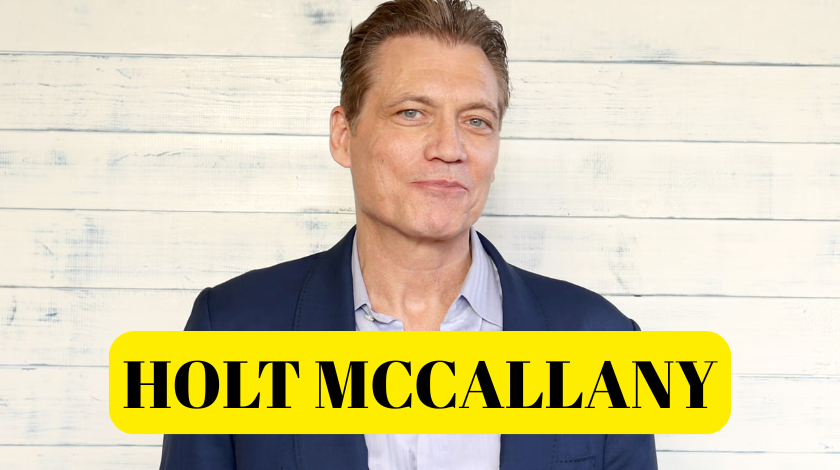
If you have found yourself here, you have likely had a certain kind of moment. You were watching a movie or a TV show—maybe it was the gripping crime drama Mindhunter, or perhaps the epic gangster film The Irishman—and you saw a familiar face. A man with a strong, grounded presence, a voice that carries a quiet authority, and a face that seems to have lived a thousand lives. You thought, “I know him. He’s always great. What’s his name?” That name is Holt McCallany.
For decades, Holt McCallany was the definition of a “that guy” actor. You had seen him in countless things, he always delivered a solid performance, but stardom, the kind where you know his name as well as you know his face, seemed to elude him. That is, until recently. What we are witnessing now is not an overnight success story, but something far more satisfying: the long-awaited recognition of a master craftsman. This is the story of how Holt McCallany, through sheer perseverance, talent, and a few key partnerships, carved out one of the most respected careers in modern Hollywood.
Act I: A Stage-Born Destiny
To understand Holt McCallany the actor, you have to start with where he came from. He wasn’t just born into the world; he was born into the world of performance. His mother was the legendary cabaret singer and actress Julie Wilson, a true star of the stage known for her sharp wit and emotional depth. His father, Michael McAloney, was a prominent theatrical producer. Holt was literally surrounded by the sounds of rehearsals, the smell of the greasepaint, and the stories of artists from his earliest days.
I remember listening to an interview where he talked about growing up in New York City, being taken to the theater, and watching his mother command a room. That kind of upbringing doesn’t just inspire you; it sets a standard. It shows you what artistry looks like up close. It is not about fame or glamour, but about the work—the discipline of getting a song right, the truth behind a line reading. This foundation gave Holt a deep, intrinsic respect for the craft of acting. He was not some starry-eyed kid dreaming of red carpets; he was a young man learning a trade from some of its best practitioners.
He chose the path of the warrior-artist, studying at the University of the Arts in Philadelphia and then in Dublin, Ireland, at the famous Gate Theatre. This classical training is crucial to understanding his technique. Many actors today come from a more casual, naturalistic background, but Holt learned the old-school way: voice projection, physical control, textual analysis. This is why, even in his most subdued television roles, there is a powerful technical engine running underneath. Every gesture feels deliberate, every pause has meaning.
Read Also: Greenberg Traurig: A Deep Dive into the Culture and Power of a Global Law Firm
The Grind: Paying Dues in the Trenches of Hollywood
Like almost every successful actor who wasn’t an instant sensation, Holt’s early career was a marathon, not a sprint. He moved to Los Angeles and began the slow, often discouraging process of auditioning. His first significant film role was a small, uncredited part in Alien³ in 1992. Think about that for a moment. His first big break was in a major franchise, but he was essentially an extra. That is the reality of Hollywood for 99% of actors.
Throughout the 90s, he became a familiar face in tough-guy roles. He was in Creepshow 2, he battled Steven Seagal in Under Siege, and he played a boxer in The Search for One-eye Jimmy. These roles were not glamorous, but they were work. They were lessons. He was learning how to be on a set, how to hit a mark, how to deliver a line with conviction even when the material was thin. This is the apprenticeship that every great character actor serves. You cannot learn this in a classroom; you learn it by doing, by failing, and by doing again.
A pivotal moment came in 1999 with David Fincher’s Fight Club. While Brad Pitt and Edward Norton were the dazzling stars at the center of the film, Holt played “The Mechanic,” a key member of their underground project. It was a small but memorable role. More importantly, it was his first professional interaction with David Fincher, a director known for his meticulousness and his eye for talent. Fincher noticed Holt. He saw something in his grounded, no-nonsense authenticity. This professional relationship, built on mutual respect, would prove to be the most important of Holt’s career, though its full flowering would have to wait another eighteen years.
The Fincher Connection: A Meeting of Meticulous Minds
If Holt McCallany’s early career was about searching for his place, his collaboration with David Fincher was about finding his perfect artistic home. Fincher is a director who prizes authenticity above all else. He is notorious for doing dozens of takes, not because he is a tyrant, but because he is searching for a specific kind of truth—a moment that feels un-acted, completely real. This demanding process is not for every actor, but for Holt, it was a perfect match.
Their first major collaboration after Fight Club was the Netflix series Mindhunter. Fincher was the driving creative force behind the show, and he cast Holt in the lead role of Bill Tench, a veteran FBI agent in the Behavioral Science Unit. This was not just another role; it was the role. Tench is the steady, pragmatic, sometimes cynical counterpart to Jonathan Groff’s more enthusiastic and theoretical Holden Ford.
What Holt did with Bill Tench is a masterclass in subtle acting. Tench is a man of few words, but you can always see the gears turning in his head. He is often frustrated, both with the bureaucratic red tape of the FBI and with the unsettling nature of the serial killers they interview. Holt portrays this not with big, explosive outbursts, but with a weary sigh, a clenched jaw, a quiet moment of staring into the middle distance. He is the anchor of the show, the character who connects the audience to the horrifying reality of what they are witnessing.
I have spoken to many people about Mindhunter, and the universal praise is for Holt’s performance. We believe he is a real FBI agent. We feel the weight of his job, the strain it puts on his home life with his wife Nancy and his troubled adopted son, Brian. There is a profound sadness in his eyes as his marriage falls apart, a sadness he cannot articulate because he is a man trained to suppress his emotions. This is not easy to pull off. It requires an actor who trusts the camera to see his internal life. Holt McCallany has that trust, and David Fincher’s camera rewarded him for it.
The Star-Making Role: Deconstructing Bill Tench in Mindhunter
Let us take a deeper look at why Bill Tench was such a perfect vehicle for Holt’s talents. The character is a composite, based on real-life FBI agent Robert K. Ressler. He is a former hostage negotiator, a man who has seen the worst of humanity and has developed a thick shell to protect himself.
One of the most brilliant aspects of Holt’s performance is his physicality. Bill Tench moves through the world with a specific, recognizable gait. He is solid, a little stiff, the posture of a man who has spent years in a suit and tie, often in stressful situations. Watch him in the interview scenes with killers like Edmund Kemper or Charles Manson. While Holden Ford leans forward, eager and fascinated, Bill Tench often leans back. He observes. He is guarded. He is not there to befriend these men; he is there to study them as a scientist would study a dangerous animal. Holt uses his body to create a visible barrier between himself and the evil he is confronting.
Then there is the voice. Holt employs a low, measured, almost gravelly tone for Tench. It is the voice of experience, of someone who does not need to raise his voice to be heard. When he does get angry, the intensity comes from the control, not the volume. It is a far more powerful and frightening choice.
The real genius of the performance, however, lies in how he handles Tench’s personal life. The show brilliantly juxtaposes the horrors of his work with the quiet disintegration of his family. As he tries to understand the psychology of murderers, his own son is involved in a deeply disturbing incident. Holt plays these domestic scenes with a heartbreaking helplessness. He is a man who can profile a serial killer but cannot connect with his own child. The frustration and grief he feels are palpable, yet he remains, as always, contained. It is a devastating and incredibly human portrait of a good man being slowly crushed by forces he cannot control.
Life After Mindhunter: A Career in Full Bloom
The success and critical acclaim of Mindhunter fundamentally changed the trajectory of Holt McCallany’s career. He was no longer just a “that guy”; he was Holt McCallany, the star of a prestige television show. This new level of recognition opened doors to even more high-profile projects with the industry’s top directors.
Most notably, he reunited with Martin Scorsese (he had a small role in The Gangster Chronicles much earlier) for the 2019 epic The Irishman. He played a labor union official, and while his screen time was limited, sharing the screen with legends like Robert De Niro, Al Pacino, and Joe Pesci in a Scorsese film is a testament to the respect he now commands. He was no longer just a background player; he was part of the ensemble in one of the most significant films of the decade.
He also appeared in Guillermo del Toro’s Nightmare Alley, further cementing his status as a go-to actor for A-list directors who need someone with immense gravitas. He played a carnival worker, a role that allowed him to tap into a different, grittier archetype. It is this versatility within his specific type—the authoritative, world-weary man—that makes him so valuable. He is not playing the same character over and over; he is exploring different facets of a similar archetype, finding the unique humanity in each one.
Even with the unfortunate and much-lamented cancellation of Mindhunter, Holt’s career has never been hotter. He has continued to work steadily in film and television, often in roles that feel tailored to his specific strengths. He has proven that talent and perseverance can win in the long run. He did not become a star in his twenties; he became one in his fifties, on his own terms, by being exceptionally good at his job.
Conclusion: The Reward of Patience and Craft
The story of Holt McCallany is more than just a Hollywood biography. It is a lesson in dedication. In a world obsessed with instant virality and fleeting fame, his journey is a powerful reminder that some of the best things are built slowly, with care and commitment. He spent thirty years honing his craft, taking small roles, learning from every experience, and never giving up on his passion.
He is the embodiment of the character actor—an artist who serves the story, who makes everyone around him better, and who finds the truth in every character, no matter how big or small. When you see Holt McCallany on screen, you are not just seeing an actor; you are seeing decades of experience, of training, of life. You are seeing the result of a lifelong love affair with the art of acting.
He earned our attention the hard way, and that makes his success all the more meaningful. So the next time you see him in a film or show, you will not just think, “That guy.” You will think, “That’s Holt McCallany.” And you will know you are in the presence of a master.
Frequently Asked Questions (FAQ)
1. How do you pronounce Holt McCallany?
It is pronounced “Holt Muh-CAL-uh-nee.” The emphasis is on the “CAL” syllable.
2. Is Holt McCallany really a boxer?
While he is not a professional boxer, he is a dedicated martial artist and has trained in boxing for many years. He is known for his physical preparation for roles, especially those requiring a fighter’s physique, like in the film Lights Out.
3. Why was Mindhunter cancelled?
Netflix and David Fincher never gave one single official reason, but it is widely reported that the show was very expensive to produce and had a demanding production schedule. David Fincher’s busy schedule and the show’s relatively niche (though dedicated) audience were also likely factors. It was less “cancelled” and more that Fincher and Netflix chose not to move forward with a third season.
4. Who are Holt McCallany’s parents?
His mother was the famous cabaret singer and actress Julie Wilson. His father was Michael McAloney, a theatrical producer.
5. What is one of Holt McCallany’s most underrated performances?
Many point to his lead role in the FX boxing drama Lights Out (2011). He played Patrick “Lights” Leary, a retired heavyweight champion struggling with financial and family problems. It is a raw, powerful performance that showcases his range and physicality and deserved a much larger audience.


